The Climate Crisis Is Showing Why Child Care Belongs in Schools

The Adaptation Bridge is using Ontario as a case study to demonstrate how climate adaptation can unlock a new vision for public education. As extreme heat, wildfire smoke, and other disruptions become more frequent and intense, schools will need to operate as integrated community infrastructure rather than instructional spaces alone. Daycare represents a key component of integrated community services. While Ontario has schools with pre-school daycares and before and after school programs, they are not integrated with schools; operating instead as separate entities, and only in some schools.
Ontario is currently implementing the Canada Wide Early Learning and Child Care (CWELCC) system, with the federal funding provided (to all provinces) to increase family access to affordable daycare. The working relationship between licensed daycares and schools in Ontario is historically complicated. There are waiting lists for daycare, but it is only offered in some schools and not others, even if they have space. These issues relate to long-standing governance design. Why don’t more schools, or even every school, have daycare? And what impact is the CWELCC having on community daycares in Ontario? What is the status and impact of that process, and what is its connection with the climate crisis?
Ontario’s Governance Model Defines Schools as Education Only Facilities
Governance policy in Ontario continues to interpret schools as education only facilities; separate from the everyday services that many children, youth, and families rely upon. That separation is the result of system design structures that reflect the era of the post war baby boom when many new schools were built and most families had two parents, with one (the mother) available throughout the day.
But today’s families are barely recognizable from the post war era. They are predominantly dual income, many single parent, and many with children and youth that need basic daily food and other supports. System adjustments to accommodate childcare and breakfast programs in schools help to fill these gaps, but they remain limited to the same general post war governance structures that define how schools are to function. School boards are not licensed childcare operators. Childcare and early‑years programs operate under the Ministry of Education’s Early Years and Child Care Division, with separate funding streams. School boards must coordinate with this division, but they are governed through the Ministry’s K–12 funding model.
The CWELCC/School District Divide
Canada’s availability of affordable childcare has not kept pace with the needs of today’s families. To help address this, the federal government introduced the Canada Wide Early Learning and Child Care system in 2022. Through grants to the provinces, it aims to give more families access to significantly reduced childcare costs, with a target of ten dollars per day per child.
Ontario’s governance model shapes how the Canada Wide Early Learning and Child Care system is implemented across the province. When Ontario signed onto CWELCC, the agreement was intended to run until March 31, 2026. Implementation delays have extended the process, and federal funding is now committed well beyond the original timeline. This is a moment when the province could significantly expand childcare spaces in schools.
With licensed child care and school operations governed separately within the Ministry of Education, Ontario’s implementation of CWELCC in schools follows a multi‑step process shaped by distinctly separated funding and frameworks:
The Ministry of Education’s Early Years and Child Care Division sets the total amount of childcare funding available, including CWELCC.
Municipal service system managers determine where childcare expansion will occur and which operators will receive funding, engaging school boards as part of their planning.
School boards identify whether school space is available and appropriate for childcare use, working within the constraints of the K–12 funding and capital model.
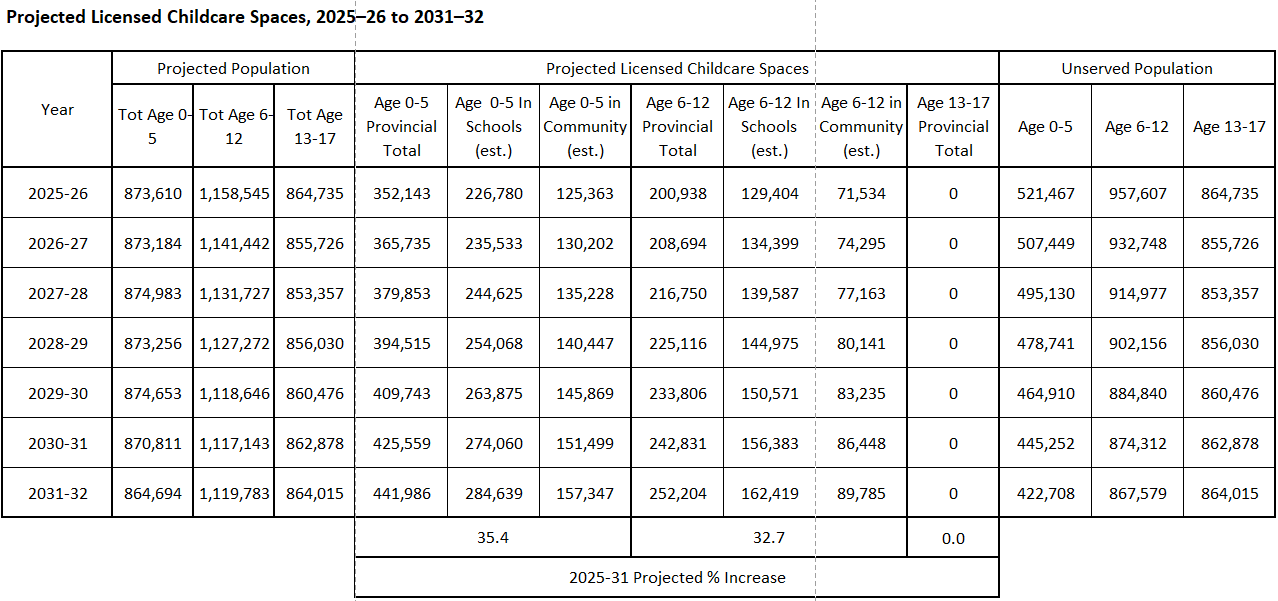
This process flow results in CWELCC expansion that is not aligned with the full potential of school district capacity, even when schools have space that could support additional childcare. To better understand the effectiveness of Ontario’s implementation of the CWELCC grants, including in schools, I went to two main data sources; namely, the Ontario Early Years and Child Care Annual Report 2025 and the Ontario Ministry of Finance Population Projections to produce the following table.
What the Data Show, and Don’t Show, About the CWELCC Objective
The stated objective of the CWELCC grants to provinces is “to ensure all families in Canada have access to high quality, affordable, flexible, and inclusive early learning and child care, no matter where they live.”
The table above does not address affordability, which relates to parent fees and provincial subsidies. Instead, it speaks directly to the other two elements of the federal objective. “All families” and “access” relate to increasing the number of available licensed spaces. “Flexible and inclusive early learning and child care” connects most directly to the issue at hand, because public schools are the most logical and accessible locations for childcare.
Re: Access
The table above uses Ontario’s child population projections as a benchmark to quantify and assess the number of licensed child care spaces being made available. It shows that, despite more than a 30% projected increase in licensed spaces by 2031, there will still be more than 420,000 preschool‑aged children from birth to age five and more than 860,000 school‑aged children from age six to twelve without access to licensed childcare.
Population data for youth ages thirteen to seventeen in the table offers further perspective, emphasizing that no licensed childcare is actually provided in Ontario for this age group which is projected to exceed 860,000 in population by 2031. So how big is 420,00 and 860,00 of unmet spaces in relation to real access need? The increase in spaces provided through CWELCC require more context than is available from the annual report for strategic direction moving forward.
Re: Flexible and Inclusive
At the heart of the CWELCC objective for flexible and inclusive childcare is recognizing that schools are where children and youth spend most of their time. Flexibility and inclusiveness are maximized when preschool childcare is located in schools, because this is where children will transition for kindergarten and where their siblings already are. Locating childcare in schools also reduces daily travel, supports continuity of care, and creates a more stable environment for families.
Beyond pre-school daycare, the often overlooked issue of flexibility and inclusiveness relates to before and after care. This is the most difficult aspect to understand from the lack of available data, yet it is central to how families experience the childcare system. Parents typically work eight or nine hour days, while children and youth in Ontario attend school for about six and a half hours, including five hours of instructional time. The gap between the length of the school day and the length of the work day is a structural reality that families must navigate. When this gap is not addressed, flexibility and inclusiveness are compromised.
The need for before and after care is also shaped by the increasing number of children and youth who rely on schools for basic food, mentoring, and social support. Neglecting the before and after care gap in Ontario schools represents a missed opportunity to solidify daily support systems for children and youth.
As evidenced by the column of 0’s in the age 13-17 column of the table, this age group is not represented in Ontario childcare governance. This is a policy gap that misses the potential for schools to provide structured supports that extend beyond the instructional day for older youth. A more flexible and inclusive interpretation of childcare in schools would open access to mentoring, learning support, tutoring, clubs, mental health resources, and other forms of guidance that many youth need. These supports are not childcare in the traditional sense, but they are part of the broader ecosystem of care that schools are uniquely positioned to provide.
Data Reporting Inconsistencies
It is worth noting that the childcare figures for ages 0-5 and 6-12 had to be proportionally estimated from the verified 0-12 totals provided in the annual report. Age groups and location categories do not connect, and there is no data specific to school located childcare spaces by age group.
A further challenge involves the continued use of the 0-5 age group to represent preschool, even though Ontario’s publicly funded education system includes Junior Kindergarten for four‑year‑olds and Senior Kindergarten for five‑year‑olds. This mismatch between licensing categories and school programs creates inconsistencies when assessing childcare access in relation to schools.
These reporting limitations illustrate the gap that exists when Ontario’s schools are regulated separately from childcare, adding to the need for a coherent dataset to continually assess where childcare capacity actually exists relative to school operations.
A Persistent Governance Issue
Ontario has attempted once before to build the kind of integrated, school anchored service model envisioned in the Adaptation Bridge. In 2015, following the release of Community Hubs in Ontario: A Strategic Framework and Action Plan, the province began a multi-year process to explore community hubs in schools, including co located child care, before and after school care, early years programming, health services, and social supports. The advisory group report captured widespread feedback that schools were a logical anchor for integrated services, noting that child care in schools provides families with accessible care and an easier transition when children go onto Full Day Kindergarten. This reflected a clear provincial understanding that school-based integration could improve access, flexibility and support for families.
The process ultimately dissolved because of structural barriers identified in the report itself including multiple planning tables, different mandates, complicated relationships, and the competing geographical boundaries of school boards, municipalities, consolidated municipal service managers, district social services administration boards, local health integration networks, and other agencies. The report also highlighted a critical funding barrier. When external agencies occupy school space for child care or before and after care, only the instructional student space is funded by the Ministry of Education. Space used by external partners is not funded, which means the school must treat that area as surplus to the needs of education. This creates a structural disincentive for integrated services and places boards in a position where they cannot sustain shared use without absorbing costs.
Within a couple of years, the initiative quietly ended without evaluation or sunset report. The failure of the community hubs in schools initiative was not due to a lack of effort, vision, or desire. It was and continues to be governance related. Ontario needs an education anchored governance structure capable of aligning ministries, funding streams, and operational responsibilities. The Adaptation Bridge is accounting for this history, noting that at that time, the climate crisis was not identified as a driving element for change. The governance issue at hand becomes even more evident when viewed through the lens of the climate era upon us.
The Climate Crisis Connection
At the time of this article, Ontario is experiencing unprecedented wildfire smoke, with air quality repeatedly reaching very high‑risk levels. Daycares and early‑years programs are being forced indoors, often in spaces that do not have HVAC systems capable of handling prolonged extreme heat and wildfire smoke.
If Ontario had more integrated, school‑based child care, the current situation would look very different. Families would have access to stable, predictable indoor environments for children and youth of all ages. This comes at a time when Ontario schools also have a critical need for HVAC upgrades. Yet schools sit closed for the summer, even as the child‑care and other programs families rely on are forced indoors during extreme heat and smoke events. The result is a system where the public infrastructure that could support children during climate‑driven disruptions is unavailable, while the programs that remain open must navigate these conditions without the benefit of shared planning, space, or adaptation strategies.
With the increasing frequency and magnitude of climate impacts, families will depend more heavily on stable, predictable, locally anchored services. Extreme heat, smoke events, flooding, and overall weather disruptions will place new demands on child care, early years programs, school operations, and family life. The climate crisis is exposing the limits of the current system by demonstrating how disconnected schools are from the community services families rely on. We are missing this opportunity to redefine how we interpret schools and community services in the new era before us.
There is no reference to climate in the CWELCC, nor does the province’s platform for child‑care expansion connect with adaptation, even as the impacts of the climate crisis are becoming increasingly evident. Without this frame, Ontario’s daycare system will remain disconnected from the conditions families will face in the years ahead.
A Call to Ontario’s Daycare and Other Service Providers
The need for integrated, school‑based child care now extends beyond the structural constraints that have slowed its advancement. CWELCC is a meaningful public investment in early‑years services and an opportunity to reconsider how child care is organized and delivered, but its potential is not being fully recognized.
The previous attempt by the Ministry of Children and Youth Services to advance community hubs in schools stalled because the system is not designed for successful cross sector coordination. The education sector could not engage meaningful change across school districts that compete for per-pupil funding.
Ontario schools are now trying to balance overlapping challenges related to mental‑health, food insecurity, and community service gaps that are being magnified by climate disruptions. These are necessary supports that schools were never designed, nor intended, to manage as education only facilities. Moving beyond this predicament requires service professionals to step forward to promote a governance shift that supports integrated services in schools.
A shift toward more school based delivery would be mutually beneficial. It would create a structure that aligns with the value that childcare, early years, and community service professionals provide, while giving schools the organizational support they need to meet emerging climate era realities. This moment calls for service providers to help shape a governance model that reflects how families actually experience the system and how communities will need to function in the years ahead.
The Time is Now
Ontario is entering a climate era that will place new demands on child care, early‑years programs, and the broader network of services that families rely on. The current governance model was built for a different time and is not equipped to meet these realities. The province’s implementation of CWELCC is meaningful, but its potential must be understood as extending beyond affordability and expansion. It holds the potential to reconsider how schools and child‑care providers can work together to best support families.
CWELCC cannot, on its own, redesign strategic governance. But it does offer a rare moment for Ontario to advance a deeper relationship between child care and school operations. The time is now for both sectors to benefit from an integrated system that supports families and communities in the years ahead.
Phil Dawes
July 19, 2026